Cancer risk: Cancer does not have to be more common to be more deadly
By Dr Itunuoluwa Johnson-Sogbetun (Dr Sho) · Module content by Dr Sharon Akinola
9 min read
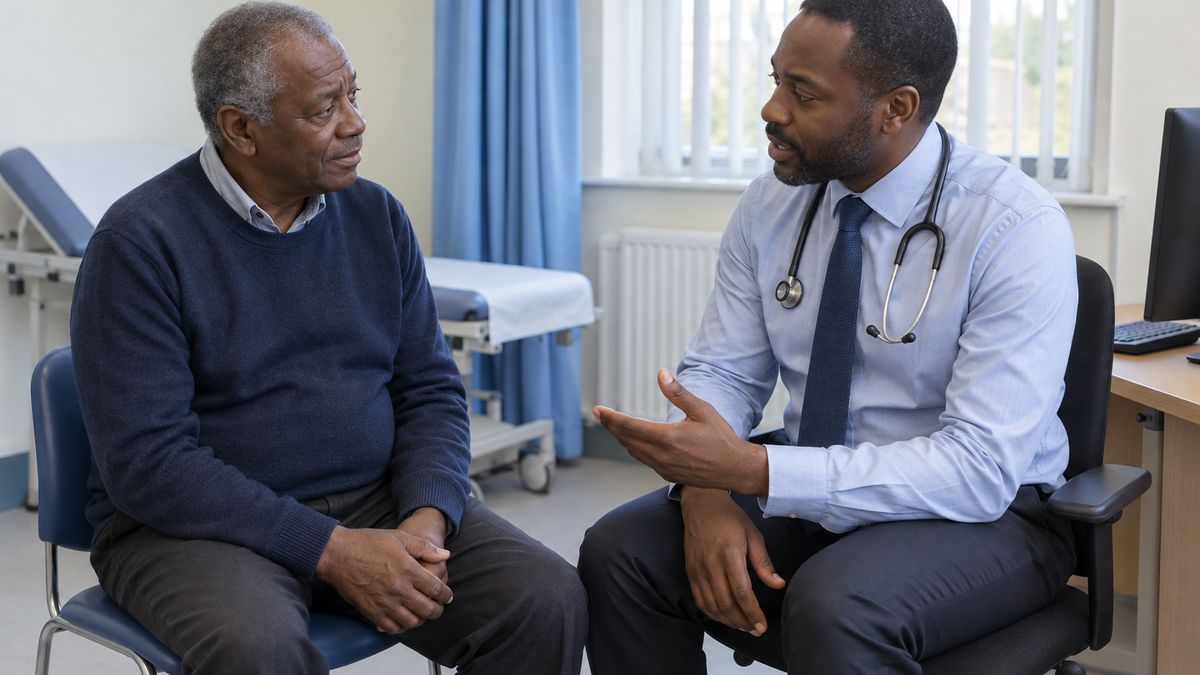
In short: Most cancers are not more common in Black people in England, but they are more often found at a later stage, when they are harder to treat. Knowing the warning signs, taking up every NHS screening invitation and asking about prostate testing from 45 are the most powerful ways to close that gap.
Key takeaways
- Black women in England are more likely to be diagnosed with breast and bowel cancer at a late stage.
- Triple-negative breast cancer, an aggressive type, is more common in Black women and in women under 40.
- About 1 in 4 Black men will get prostate cancer; Prostate Cancer UK advises talking to your GP about PSA testing from 45.
- NHS screening in England covers breast (50 to 71), bowel (50 to 74) and cervical (25 to 64) cancers.
Here is the fact that frames everything in this piece: a cancer does not have to be more common in Black people to be more deadly for us. In the US, Black people are more likely to die from most cancers, and to live for a shorter time after diagnosis, than any other ethnic group. In England, Black people have lower rates of most cancers than white people, but are more likely to be diagnosed at a later stage for several of them. The problem is not only the disease. It is when we find it, and the care we receive once we do.
In this piece I focus on the cancers where the gaps are widest (breast, prostate, bowel and cervical cancer) and on the single most powerful thing we can do about them: detect them early.
Where the gaps are
Several factors combine to put Black people at greater risk of dying from cancer:
- Black people are more often diagnosed with late-stage breast and bowel cancer, which is harder to treat.
- Obesity rates are higher among Black adults, which adds to cancer risk.
- Higher smoking rates among Black men contribute to deaths from lung cancer.
- Uptake of the HPV vaccine, which prevents cervical cancer, is low in the Black community, and we see higher death rates from cervical cancer as a result.
- The supportive care people need to survive cancer is harder for Black people to access.
The breast cancer figures are stark. In the US, Black women are 40% more likely to die from breast cancer than white women, even though fewer are diagnosed with it, and among women under 50 the death rate is about twice as high. In England, Black women are more likely to be diagnosed at a later stage.
For cervical cancer, in the US, Black women are 41% more likely to develop it and 75% more likely to die from it than white women. In many parts of Africa, cervical cancer is one of the most common cancers in women and a leading cause of cancer death. That is heartbreaking, because cervical cancer is one of the most preventable cancers we have.
Breast cancer: know what is normal for you
Common signs include a lump, a change in breast shape, dimpling of the skin, discharge from the nipple, and breast pain. Pain on its own is not usually a sign of cancer, but new pain, pain in one breast only, or a change in your usual breast pain should always be checked. In fact, any change you are not sure about deserves a check.
This matters because Black women are at higher risk of aggressive breast cancers such as triple-negative breast cancer, and we are more likely to develop breast cancer at a younger age. A family history of breast cancer increases risk, as do inherited mutations such as BRCA1 and BRCA2, which are also found in the Black community. Smoking, alcohol, inactivity and obesity all raise the risk further.
Please check your breasts every month. You can do it in the shower. Get to know what is normal for you so that you notice if something changes.
Prostate cancer: do not wait until 50
Symptoms can include difficulty passing urine, waking at night to urinate, needing to go more often, blood in the urine or semen, erectile dysfunction, and pain in the lower back, hips or pelvis. Many of these can also be caused by other things, such as a urine infection, but if they are new, get checked.
Risk rises with age, and for most men it is higher after 50. But Black men have double the risk, their risk starts to rise from the age of 45, and they are more likely to be diagnosed with advanced disease. Having a close relative with prostate cancer, or a genetic mutation that runs in the family, increases risk too.
There is no national prostate cancer screening programme in the UK. So from 45, or earlier if you have symptoms, ask yourself: am I having problems passing urine? Is my flow weaker? Am I waking at night to go? If the answer to any of these is yes, see your doctor. And even without symptoms, if you are a Black man aged 45 or over, or you have a family history, ask your GP about your risk and the PSA blood test. The UK National Screening Committee now recommends screening only for men aged 45 to 61 with a BRCA2 gene change and a family history of cancer, not for Black men as a group, but you still have the right to ask. Neither the PSA test nor an examination is perfect, but together they are an important way of detecting prostate cancer early.
Bowel cancer: "it's only poo in a pot"
Watch for a change in bowel habit, blood in your stool, abdominal pain, unexplained tiredness and unexplained weight loss. Risk rises significantly after 50, and a family history of bowel cancer, or an inherited mutation, increases it. A diet high in processed meat and low in fibre, a lack of physical activity, and smoking all add to the risk.
If you have any of these symptoms, see a doctor. And when the NHS bowel screening test kit comes through your door, please do it. Do not say it is disgusting. It is only poo in a pot, and it saves lives. Uptake in the Black community needs to improve.
Cervical cancer: go for your screening
Warning signs include bleeding between periods or after sex, pelvic pain, pain during sex, and a change in vaginal discharge. These can have many other causes, but they need checking. Risk rises notably from the age of 30, though if you are younger and have symptoms, you should still be seen.
HPV infection is the main cause of cervical cancer, which is why vaccination has been so transformative. When young people, girls and boys, are vaccinated in their teenage years at school, we dramatically reduce the risk. We need uptake to increase in the Black community to protect our young people.
I also want to get this message across as clearly as I can: go for your cervical screening. Infrequent screening raises your risk, and uptake among Black women is low. Screening detects problems early, before they become cancer. Yes, it can be uncomfortable, but a few seconds of discomfort, every few years when you are invited, can save your life. Smoking and conditions or medications that weaken the immune system also raise the risk.
Why trust and representation matter
It pains me to see Black people dying unnecessarily from cancers that could have been prevented or detected early. Part of the answer is seeing doctors and nurses who look like you, because a diverse workforce helps fight the misinformation about cancer that circulates in our communities.
I understand that there is distrust of the Western medical system, and that it comes from bad things that happened in the past. But we need to be trusted by our own communities. That is exactly why we created HEAL: as members of the community, telling you that early detection is a game changer in cancer care.
How we prevent cancer and survive it
- Screening: take up every screening you are offered. In England, breast screening is offered from 50 up to your 71st birthday every three years, bowel screening from 50 to 74 every two years, and cervical screening from 25 to 64 every five years.
- Support networks: find people who can share accurate information and experience.
- Self-advocacy: tell your doctor, "I am a Black man, I am 45 and I am worried about my risk. Can I have a prostate check?" or "I have a family history and I want to make sure I am okay."
- Early intervention: if you are diagnosed, please engage with treatment. Some of us are so frightened of a cancer diagnosis that we run away from it, but early treatment matters.
- Community effort: working with community and religious leaders to reduce cancer risk together.
- Cultural sensitivity: these subjects are sensitive, and some people have had terrible experiences, but approached in a culturally competent way, we can and must talk about them.
- Genetic counselling: if you know of a family history or a genetic mutation, speak to your doctor.
- A healthy lifestyle: avoid smoking, keep alcohol moderate, maintain a healthy weight, stay active and eat well.
Early detection saves lives. Please share this piece, and let us get this information to the people who need it.
Watch the original HEAL talk
Watch Dr Itunuoluwa Johnson-Sogbetun's HEAL for Black People talk on YouTube (13:27)
Frequently asked questions
In the US, Black women are about 40% more likely to die from breast cancer than white women, despite slightly lower rates of diagnosis. In England, Black women are more likely to be diagnosed at a later stage, when treatment is harder. Knowing what is normal for your breasts and attending NHS breast screening from 50 helps catch it earlier.
There is no national prostate screening programme for Black men. Prostate Cancer UK advises Black men aged 45 and over to talk to their GP about their risk and the PSA blood test. Your GP will explain the benefits and downsides first. If you have urinary symptoms at any age, see your GP.
In England, everyone aged 50 to 74 who is registered with a GP is sent a home test kit (FIT) every 2 years. You collect a small sample of poo and post it back. If you are 75 or over, you can ask for a kit by calling the free helpline on 0800 707 6060.
In England, women and people with a cervix aged 25 to 64 are invited for cervical screening every 5 years. The test checks for high-risk HPV, the main cause of cervical cancer. If you have symptoms such as bleeding after sex or between periods, see your GP; do not wait for your invite.
- Differences in cancer incidence by broad ethnic group in England, 2013 to 2017 (reported as "First data in a decade highlights ethnic disparities in cancer"), Cancer Research UK / British Journal of Cancer, 2022
- New analysis reveals Black women in England more likely to be diagnosed with late-stage cancer, Cancer Research UK (BMJ Open study), 2023
- Triple negative breast cancer, Cancer Research UK, current page
- Breast Cancer Facts and Figures 2022 to 2024 press release, American Cancer Society, 2022
- Black men and prostate cancer, Prostate Cancer UK, current page
- UK NSC recommends prostate cancer screening for men with a BRCA2 gene change and family history of cancer, Cancer Research UK news, May 2026
- Bowel cancer screening. NHS, current page
- Cervical screening: when you'll be invited. NHS, current page
- Who breast screening is for. NHS, current page
Read next in the HEAL series
All articles in the HEAL series Men's health
Brothers, it is time we talked
1 in 4 Black men will get prostate cancer. A UK GP explains PSA testing from 45, enlarged prostate, erectile problems and when to see your GP.
Dr Derek Adu-SarkodieVideo length 16:48 Skin health
Our skin is not immune
Eczema, scalp conditions, acne marks and skin cancer look different on Black skin. A UK doctor explains the signs, care routines and when to see a GP.
Dr Yvonne AbimbolaVideo length 19:50 Conclusion
From struggles to solutions
Practical steps to get heard in the NHS, plus the BRIGHT CARE framework for clinicians, from UK GP and health educator Dr Tosin Ajayi-Sotubo.
Dr Tosin Ajayi-SotuboVideo length 15:16